Learning Outcomes
This article examines estate administration involving known and unknown beneficiaries, including:
- the core duties, powers, and personal liability risks of executors and administrators when identifying, verifying, and dealing with beneficiaries
- methods and evidential requirements for tracing beneficiaries, such as genealogical research, professional tracing agents, and carefully drafted public notices
- the operation, wording, timing, and protective scope of statutory advertisements under section 27 of the Trustee Act 1925
- the nature, purpose, evidential threshold, and consequences of obtaining a Benjamin order for court‑authorised distribution on assumed facts
- key protections available to personal representatives, including section 27 protection, Trustee Act 1925 section 61 discretion, and missing‑beneficiary insurance
- the distinction between unknown claimants and known but missing beneficiaries, and why different procedural tools apply to each category
- practical options where a beneficiary is known but cannot be located, including payment into court, indemnities, insurance, and court directions
- prudent timing of distribution and the interaction with the six‑month window for potential Inheritance (Provision for Family and Dependants) Act 1975 claims
- application of these principles to SQE1‑style multiple‑choice questions and problem scenarios, enabling precise, exam‑focused analysis and confident answer selection
SQE1 Syllabus
For SQE1, you are required to understand the practical and legal steps executors and administrators must take when dealing with beneficiaries in estate administration, with a focus on the following syllabus points:
- the statutory duties and powers of executors and administrators in identifying and locating beneficiaries
- the procedures for dealing with missing or unknown beneficiaries, including genealogical research and public notices
- the use and effect of statutory advertisements under the Trustee Act 1925
- the application and consequences of a Benjamin order
- the legal protections available to personal representatives who have made reasonable efforts to identify all beneficiaries
- the duty of care under the Trustee Act 2000 and potential personal liability (devastavit) for incorrect distribution
- timing of distribution and the six‑month protective period for potential claims under the Inheritance (Provision for Family and Dependants) Act 1975
- options where a beneficiary is known but missing: payment into court, insurance, indemnities, and court directions
- practical checks: searches for bankruptcy of beneficiaries and land‑related liabilities before distribution.
Test Your Knowledge
Attempt these questions before reading this article. If you find some difficult or cannot remember the answers, look more closely at that area during your revision.
- What is a Benjamin order, and when might an executor seek one?
- What is the effect of placing statutory advertisements under section 27 of the Trustee Act 1925?
- What steps should an executor take if a beneficiary cannot be found?
- What legal protection does an executor have if a missing beneficiary appears after the estate has been distributed?
Introduction
When administering an estate, personal representatives (executors or administrators) must identify and pay all beneficiaries entitled under the will or intestacy rules. This process is usually straightforward when beneficiaries are known and easily located. However, complications arise when beneficiaries are unknown, missing, or cannot be traced. Executors must take reasonable steps to identify and locate all beneficiaries, as failure to do so may result in personal liability if assets are distributed incorrectly.
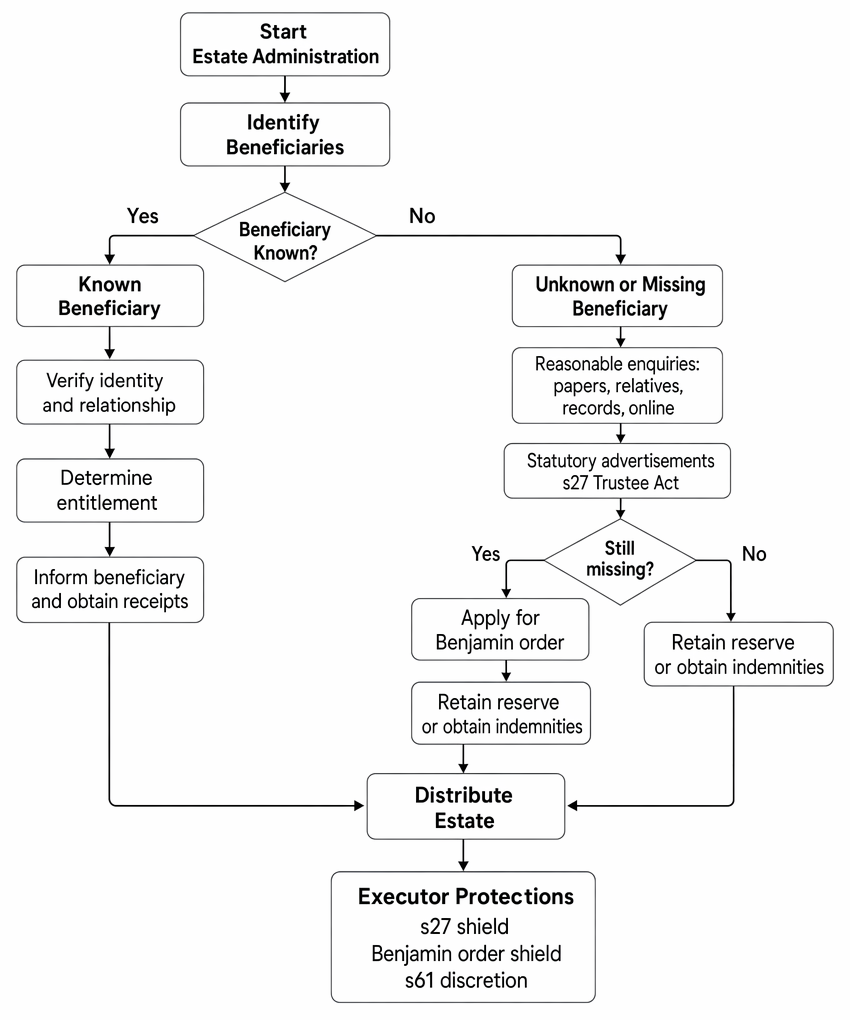
Estate administration involving known, unknown, and missing beneficiaries includes identification, tracing, statutory advertisements, Benjamin orders, distribution, and personal representatives’ protections.
This duty is underpinned by the Administration of Estates Act 1925 section 25: personal representatives must collect and get in the estate and administer it according to law. Their fiduciary duty of care is informed by the Trustee Act 2000; if a breach causes loss, they may be personally liable. The court has a discretion under Trustee Act 1925 section 61 to relieve a personal representative who acted honestly and reasonably, but this depends on the facts and the quality of the enquiries made.
Key Term: personal representative
A person (executor or administrator) responsible for administering a deceased person's estate.
If a beneficiary is known but cannot be located, or if it is unclear who is entitled, the personal representative must take active steps to resolve the issue before distributing the estate. It is also prudent to delay distribution for six months from the date of the grant to avoid personal exposure to claims under the Inheritance (Provision for Family and Dependants) Act 1975.
Duties of Personal Representatives
Personal representatives have a duty to collect in the assets of the estate, pay debts and liabilities, and distribute the balance to the correct beneficiaries. This duty includes identifying all persons entitled under the will or, if there is no will, under the intestacy rules.
They must administer with due diligence and reasonable care, preserving assets and applying them correctly. If they distribute to the wrong person or fail to pay a rightful creditor or beneficiary, they may commit a devastavit and be personally liable for the resulting loss. Although personal representatives have broad administrative powers (including powers of sale, appropriation, investment and insurance), those powers must be exercised in the interests of the estate as a whole and consistently with beneficiaries’ entitlements.
Reasonableness is judged by the steps taken: reviewing the will’s terms, identifying the class of beneficiaries, confirming relationships, considering any trust structures in the will, and making thorough efforts to trace those who are missing. Good record‑keeping is essential to demonstrate that reasonable enquiries were made.
Identifying Known Beneficiaries
Where beneficiaries are named in the will or are easily identified under the intestacy rules, the executor must verify their identity and entitlement. This usually involves obtaining proof of identity and, where necessary, evidence of relationship to the deceased (such as birth or marriage certificates). In class gifts (for example, “my children”), personal representatives must determine who falls within the class. As a general rule, “children” includes biological and adopted children but not step‑children unless the will clearly indicates otherwise. Adoption is treated as full parent‑child status for succession purposes, and assisted reproduction rules in the Human Fertilisation and Embryology Act 2008 govern legal parenthood in relevant cases.
If a beneficiary is a minor or lacks capacity, the executor must ensure that payment is made to a suitable trustee or guardian. Under the Administration of Estates Act 1925 section 42, personal representatives may appoint trustees to hold a minor’s legacy; receipt from those trustees is a valid discharge. Parents and guardians can typically give a good receipt for a minor’s benefit under the Children Act 1989. Where a beneficiary lacks capacity, payment should be made to a Court of Protection‑appointed deputy or in accordance with a valid lasting power of attorney as appropriate.
Beneficiary insolvency is a practical risk. Personal representatives should check the Individual Insolvency Register to ascertain whether a beneficiary is bankrupt; if so, payment may need to be made to the trustee in bankruptcy rather than to the beneficiary personally.
Key Term: beneficiary
A person entitled to receive a share of the estate under a will or the intestacy rules.
Dealing with Unknown or Missing Beneficiaries
When a beneficiary is unknown, missing, or cannot be found after reasonable enquiry, the executor must take further steps to avoid personal liability. A helpful distinction is between unknown claimants (people whose entitlement is not known to the personal representatives) and known but missing beneficiaries (people whose entitlement is known but whose whereabouts are not). Section 27 statutory advertisements protect against the former; other measures are required for the latter.
Reasonable Enquiries
Reasonable steps to identify and locate beneficiaries may include:
- examining the deceased's personal papers and correspondence
- contacting known relatives and friends
- searching public records (birth, marriage, death, and adoption registers; electoral rolls)
- instructing genealogists or tracing agents, and reviewing their reports
- using online searches and social media; engaging with professional networks or community groups relevant to the deceased
- checking with the Department for Work and Pensions, HMRC, and, where relevant, overseas consulates or registries for international links
- confirming whether any earlier address records (utility bills, bank and pension statements) offer leads
- verifying that no caveat or citation has been entered which might affect grant or entitlement
Keep a detailed log of all enquiries, responses, and the time and cost involved. This will be evidence of “reasonable enquiry” should protection under Trustee Act 1925 section 61 be relied upon or court directions sought.
Statutory Advertisements
Personal representatives are advised to place statutory advertisements under section 27 of the Trustee Act 1925. These notices are typically published in the London Gazette and a local newspaper where the deceased lived or owned property. In appropriate cases (for example, where the deceased ran a business), a trade journal may be sensible. Section 27 envisages advertising in those places a court would have directed in administration proceedings, including overseas if the facts justify it.
Key Term: statutory advertisement
A public notice placed by personal representatives inviting claims against the estate, providing legal protection from unknown creditors and beneficiaries.
The notice invites anyone with a claim against the estate to come forward within a specified period (not less than two months). Best practice is to advertise early in the administration. Executors may advertise at any time after death; administrators should advertise after obtaining a grant. In addition to advertisements, prudent personal representatives should also conduct standard land and charge searches to reveal liabilities linked to the deceased’s land, and check for bankruptcy declarations against the deceased and beneficiaries.
If the executor distributes the estate after the notice period and a claim later arises, they are protected from personal liability for unknown claimants, provided they acted in good faith and without actual notice of the claim. The claimant may still trace assets into the hands of recipients and recover from beneficiaries, but the personal representatives will not be personally liable if they complied with section 27 and otherwise acted reasonably.
Benjamin Orders
If, after exhaustive enquiries, a beneficiary cannot be found, the executor may apply to the court for a Benjamin order (from Re Benjamin [1902] 1 Ch 723).
Key Term: Benjamin order
A court order allowing personal representatives to distribute an estate on the assumption that a missing beneficiary has died, protecting them from liability if the beneficiary later appears.
A Benjamin order authorises the executor to distribute the estate as if the missing beneficiary had predeceased the deceased. It does not declare death; it permits distribution on a specified assumption after full enquiries. The court will expect evidence (for example, a genealogist’s report, correspondence records, and details of advertisements and searches) showing that reasonable and comprehensive steps have failed. Costs are a factor, but the order provides strong protection: if the missing beneficiary later appears, they cannot sue the personal representatives; they may claim their share from the other recipients.
Alternatives include paying the missing beneficiary’s share into court (to the Accountant General) while distributing the rest; obtaining indemnities from the other beneficiaries; and purchasing missing beneficiary insurance. Indemnities may be of limited value if the indemnifier lacks means; insurance may require proof of exhaustive enquiries and usually covers the principal plus interest if a claim later arises.
Worked Example 1.1
An executor cannot trace one of three residuary beneficiaries despite extensive searches and placing statutory advertisements. What should the executor do before distributing the estate?
Answer:
The executor should apply for a Benjamin order, allowing the estate to be distributed as if the missing beneficiary had died. This protects the executor from personal liability if the beneficiary later appears.
Legal Protections for Executors
Personal representatives who have made reasonable efforts to identify and locate all beneficiaries are protected from personal liability in several ways:
- If statutory advertisements have been placed and the executor distributes after the notice period, they are not personally liable for claims from unknown creditors or beneficiaries. A claimant may trace assets into recipients’ hands.
- If a Benjamin order is obtained, the executor is protected from liability to the missing beneficiary because the distribution was court‑authorised on reasonable assumptions.
- If the executor has acted honestly and reasonably, the court has discretion to excuse them from liability for breach of duty under section 61 of the Trustee Act 1925.
- It is prudent to delay distribution until six months have passed from the grant, given the risk of claims under the Inheritance (Provision for Family and Dependants) Act 1975. Early distribution may result in personal exposure if a successful claim is made before the end of that period.
- Where an entitlement is known but the beneficiary cannot be found, protection can be achieved by paying the amount into court, or by distributing the remainder with appropriate insurance cover or robust indemnities, after evidence of full enquiry.
- In cases of threatened claims or uncertainty, a “put up or shut up” case management order may be sought, requiring a potential claimant to issue proceedings by a specified date or risk the personal representatives proceeding with distribution. This is used to bring clarity where threats linger without formal action.
Key Term: section 27 protection
Legal protection for personal representatives who have placed statutory advertisements and distributed the estate after the notice period.
Practical Steps When Beneficiaries Cannot Be Found
- Document all steps taken to locate the beneficiary (dates, methods, responses).
- Place statutory advertisements in the London Gazette and an appropriate local newspaper; consider a relevant trade journal and overseas notice if appropriate.
- Conduct standard searches (Land Registry, Land Charges, Local Land Charges, bankruptcy registers) regarding the deceased’s land and possible liabilities.
- Instruct a professional genealogist or tracing agent and retain their report.
- Consider payment into court for the missing beneficiary’s share, or taking out missing beneficiary insurance; assess the strength and limits of indemnities offered by other beneficiaries.
- If still unsuccessful, apply for a Benjamin order supported by evidence of exhaustive enquiries.
- Retain a reserve or escrow, or pay into court, where uncertainty persists and insurance or court orders are not yet in place; consult beneficiaries and take written instructions acknowledging the plan.
- Delay distribution for six months from the grant to address potential 1975 Act claims, unless urgent distribution is unavoidable and adequate reserves are kept.
- Verify beneficiaries’ bankruptcy status and identity before payment; where appropriate, pay to trustees or guardians for minors, or to deputies/attorneys for persons lacking capacity.
Worked Example 1.2
An executor distributes the estate after placing statutory advertisements and making all reasonable enquiries. Six months later, a previously unknown beneficiary appears and claims a share. Is the executor personally liable?
Answer:
No, provided the executor acted in good faith, made reasonable enquiries, and placed statutory advertisements, they are protected from personal liability. The new beneficiary may claim from the other recipients, not the executor.
Worked Example 1.3
Administrators advertised under section 27 and waited two months. They then paid the residue to the intestacy beneficiaries. A previously unknown creditor surfaces with documentary proof of a loan. What is the position?
Answer:
Section 27 protects the personal representatives from personal liability to unknown claimants if they advertised and acted in good faith without actual notice. The creditor may still pursue the distributed assets by tracing into the hands of recipients. If the administrators had actual notice of the debt before distribution, protection would not apply.
Worked Example 1.4
An executor cannot find a known pecuniary legatee after full enquiries. Other residuary beneficiaries offer indemnities and suggest distributing without court involvement. What are the risks and alternatives?
Answer:
Indemnities may be of limited practical value if indemnifying beneficiaries later lack funds; they do not remove the executor’s basic duty to pay the legatee. Safer options are paying the legacy into court (so the executor is discharged), obtaining missing beneficiary insurance after exhaustive enquiries, or applying for a Benjamin‑style leave to distribute. Any distribution without robust protection risks personal liability if the legatee later appears.Exam Warning: Executors must not distribute the estate without making reasonable efforts to identify and locate all beneficiaries. Failure to do so may result in personal liability for any loss suffered by a beneficiary who was overlooked. Distinguish carefully between protection against unknown claimants (section 27) and cases where entitlement is known but the person is missing (where section 27 does not protect). Do not overlook the six‑month period post‑grant for potential 1975 Act claims.
Revision Tip: Always keep detailed records of all steps taken to trace missing beneficiaries and of the advertisements placed (copies, dates, publications). Retain genealogists’ reports, search results (Land Registry, Land Charges, bankruptcy), and correspondence. This documentation is essential if you need to demonstrate reasonable enquiry, seek a Benjamin order, or defend against a claim.
Key Point Checklist
This article has covered the following key knowledge points:
- The duty of personal representatives to identify and locate all beneficiaries before distributing the estate, including the duty of care and potential personal liability for breach.
- The steps required to trace missing or unknown beneficiaries, including genealogical research, searches, and statutory advertisements.
- The use and effect of statutory advertisements under the Trustee Act 1925 section 27, including timing, publications, and the scope of protection.
- The procedure and effect of a Benjamin order, and the differences from a presumption of death.
- Practical options if a known beneficiary cannot be found: payment into court, indemnities, insurance, and court directions.
- The legal protections available to executors who have made reasonable enquiries and followed proper procedures, including Trustee Act 1925 section 61 discretion.
- The importance of delaying distribution for six months from grant to manage possible claims under the Inheritance (Provision for Family and Dependants) Act 1975.
- The importance of documenting all efforts to locate beneficiaries and checking beneficiaries’ bankruptcy status before payment.
Key Terms and Concepts
- personal representative
- beneficiary
- statutory advertisement
- Benjamin order
- section 27 protection