Learning Outcomes
This article outlines remedies against third parties in trusts, including:
- Clear identification and application of recipient (knowing receipt) and accessory (dishonest assistance) liability, focusing on required mental elements (knowledge, unconscionability, objective dishonesty) and how they are tested in problem questions.
- Analysis of corporate attribution of knowledge, the role of the directing mind, and the distinction between beneficial and ministerial receipt when assessing whether companies are personally liable.
- Comparison of personal and proprietary remedies, including constructive trusts and equitable liens, election between them, and their practical impact on enforcement, recovery, and priority in insolvency.
- Application of equitable tracing into clean substitutions and mixed funds using key authorities (Re Hallett, Re Oatway, Roscoe v Winder, Clayton’s Case, rateable distribution, backwards tracing) and the lowest intermediate balance rule.
- Evaluation of core defences and limits—bona fide purchaser for value without notice, change of position, limitation and laches (with Williams v Central Bank of Nigeria)—and when each will defeat recovery.
- Consideration of liability for intermeddlers (trustee de son tort), standards of conscience in equity, and how courts calibrate exposure of innocent volunteers versus culpable strangers.
- Planning of interim relief (freezing and proprietary injunctions, Norwich Pharmacal and Bankers Trust orders) and strategic recovery steps that candidates must address in SQE1-style scenario questions.
SQE1 Syllabus
For SQE1, you are required to understand third-party liability in trusts, with a practical focus on recovery strategy, limitation, and defences, with a focus on the following syllabus points:
- The distinction between recipient liability (knowing receipt) and accessory liability (dishonest assistance)
- The elements of knowing receipt: breach, beneficial receipt, and unconscionability based on the recipient’s knowledge
- The elements of dishonest assistance: existence of trust/fiduciary duty, breach, assistance, and objective dishonesty
- The operation of equitable tracing into clean substitutions and mixed funds (Re Hallett, Re Oatway, Roscoe v Winder, Clayton’s Case, rateable sharing, backwards tracing)
- Personal versus proprietary remedies; constructive trusts and equitable liens; priority and insolvency implications
- The full defence of bona fide purchaser for value without notice; knowledge standards and limitations
- The change of position defence and its limits; ministerial (non-beneficial) receipt; agency conduits
- Liability of intermeddlers (trustee de son tort); scope and limits of imposing trustee-like duties on strangers
- Limitation and laches, including the effect of fraud or concealment; Williams v Central Bank of Nigeria and s 21 Limitation Act 1980
- Strategic considerations: election between claims, interim remedies (freezing and proprietary injunctions), and enforcement against recipients and assisters
Test Your Knowledge
Attempt these questions before reading this article. If you find some difficult or cannot remember the answers, look more closely at that area during your revision.
-
Which doctrine applies when a third party receives trust property transferred in breach of trust, knowing circumstances that would make retention unconscionable?
- a) Dishonest Assistance
- b) Resulting Trust
- c) Knowing Receipt
- d) Proprietary Estoppel
-
What is the primary focus when establishing liability for dishonest assistance?
- a) The receipt of trust property by the assistant.
- b) The state of knowledge of the trustee committing the breach.
- c) The dishonesty of the person assisting the breach.
- d) The value of the loss suffered by the trust.
-
True or false: Tracing is a remedy in itself, rather than a process to identify assets against which a remedy can be claimed.
-
Which defence completely protects a third party who acquired legal title to trust property transferred in breach of trust?
- a) Change of position
- b) Limitation Act expiry
- c) Bona fide purchaser for value without notice
- d) Consent of one beneficiary
Introduction
When a trustee breaches duties owed to beneficiaries, and loss results or assets are misapplied, the immediate recourse is usually against the trustee for the breach. However, trusts law recognises that recovery purely against the trustee may be insufficient—especially in cases where the property has passed to others, those others have contributed to the breach, or the trustee is insolvent or untraceable. Accordingly, the law of trusts enables beneficiaries to pursue claims against third parties under two main heads: recipient liability (knowing receipt) and accessory liability (dishonest assistance). In tandem, equitable doctrines such as tracing, specific proprietary remedies, and various defences, shape what can be practically recovered and from whom.
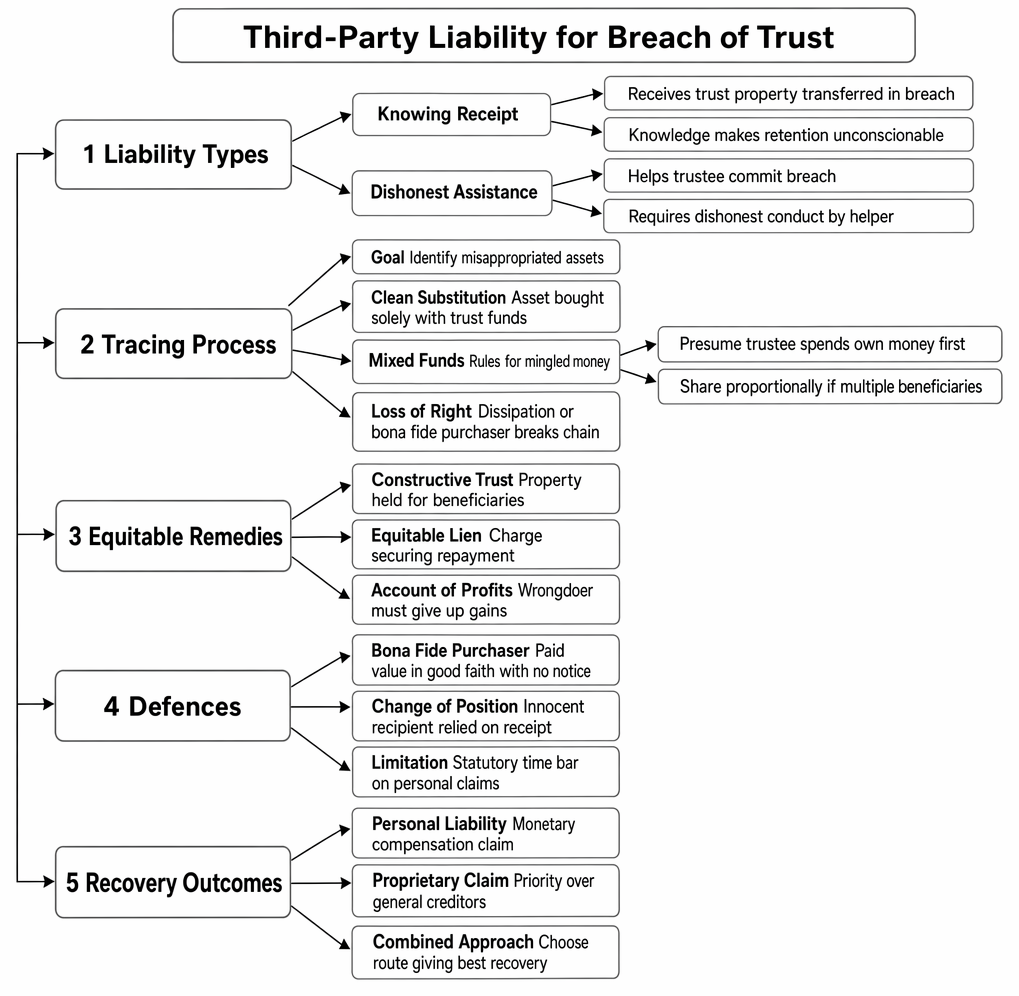
Third-party liability for breach of trust is presented through knowing receipt, dishonest assistance, tracing, remedies, defences, and personal or proprietary claims.
A central theme is the protection of the continuing equitable proprietary interest of beneficiaries. Equity supplies mechanisms to prevent unjust results in complex transactional chains, while emphasising fault thresholds—unconscionability or dishonesty—for imposing personal liability on strangers to the trust. Where the property or its traceable substitute remains, proprietary claims can be asserted in addition to, or instead of, personal claims, often radically improving practical outcomes in insolvency or where a defendant seeks to dissipate assets. This interplay also affects limitation and laches: proprietary assertions are not restrained by statutory limitation, but equitable delay may curtail relief.
In many modern disputes, the trustee is a corporate vehicle, or the misapplication is facilitated by professionals. Equity’s flexibility allows beneficiaries to pursue recipients whose retention of value would be unconscionable, and assisters whose conduct falls below objective honesty standards. It is not enough to show mere involvement; the third party must either benefit with knowledge that makes retention inequitable or assist dishonestly. Combined with tracing rules that prevent wrongdoers from profiting through mixing or substitution, the architecture is designed to produce principled and predictable outcomes across varied fact patterns.
Key Term: Tracing
The evidential and logical process of tracking the value or substance of property as it moves or is substituted into new forms, for the purpose of identifying assets against which a claimant may assert a remedy. Tracing is a means to an end: it is not a remedy in itself but a process that supports the recovery of misapplied assets, allowing for the assertion of either a proprietary or personal claim in equity.
The distinction between ‘following’ and ‘tracing’ is fundamental. Following takes place when one pursues the same asset through different hands (e.g. following a piece of art from one buyer to another), whereas tracing allows claimants to pursue new assets substituted for the original (e.g. tracking money into the purchase of a car). Tracing at common law is limited and may fail if the property is mixed; equitable tracing, however, operates where there is an initial fiduciary relationship (such as beneficiary–trustee), the claimant retains a proprietary interest, and the asset is still identifiable in substance (not dissipated or lost to exhaustion).
Key Term: Bona fide purchaser for value without notice
A person who acquires legal title to property, provides real value (not by way of gift), acts in genuine good faith, and has neither actual, imputed, nor constructive notice of a pre-existing equitable interest. As "equity's darling," such a purchaser takes free of all prior equitable interests and is immune to both proprietary and personal claims by previous beneficial owners.
The architecture of third-party claims
Beneficiaries can sue third parties on either a personal or proprietary basis. Knowing receipt and dishonest assistance are personal liabilities (although a recipient may also be subject to proprietary claims if the property or its traceable substitute remains). Proprietary claims (e.g. via constructive trust or equitable lien) confer priority in insolvency and often command better settlement position. The shape of the strategy depends on what remains traceable, the defendant’s solvency, limitation periods, and the availability of defences.
In practice, claims are commonly pleaded in the alternative: personal remedies against recipients or assisters to secure compensation and parallel proprietary claims via tracing to secure priority and capture any increase in asset value. The choice is fact-sensitive. If the substitute asset has appreciated, a constructive trust is powerful; if the value has fallen or the asset is contested by third parties, an equitable lien can avoid over-claiming while still giving effective security. Mapping the asset pathway and the points at which legal title may have passed to a bona fide purchaser for value without notice is essential: proprietary rights are extinguished at that point, and a personal knowing receipt claim may also fail in light of Byers v Saudi National Bank.
Where property has been mixed or converted, tracing rules guide allocation between competing claimants and prevent trustees and their confederates from selecting favourable allocations after the event. The litigation strategy should integrate interim relief—freezing orders to prevent dissipation and proprietary injunctions to preserve identified substitutes—together with early disclosure (Norwich Pharmacal and Bankers Trust orders) to locate assets and pin down knowledge.
Standards of conscience in equity
Equitable liability is calibrated by conscience. For knowing receipt, the controlling criterion is whether, given what the recipient knew, it is unconscionable to retain the benefit. For dishonest assistance, the touchstone is objective dishonesty, judged by the standards of ordinary decent people after ascertaining the defendant’s actual knowledge of facts. These standards align modern equity with principled fault thresholds rather than rigid formalism.
The modern approach rejects formulaic gradations of knowledge as determinative and emphasises contextual fault: what did the recipient know, or deliberately avoid knowing, that should have put a stop to retention; and what did the assister know such that proceeding crossed the line into dishonest facilitation. Cases such as Royal Brunei Airlines v Tan and Barlow Clowes v Eurotrust refocus on objective dishonesty, while Akindele provides a flexible unconscionability test for recipients. The Supreme Court in Ivey v Genting unified the test for dishonesty across civil and criminal contexts, asking first what facts the defendant actually appreciated, then whether their conduct was dishonest by the standards of ordinary people. Twinsectra v Yardley’s earlier subjective gloss has been overtaken by Ivey.
In practice, the modern approach also emphasises the timing and continuity of equitable interests. The Privy Council in Byers v Saudi National Bank [2023] reiterated that a knowing receipt claim requires the claimant to have a subsisting equitable proprietary interest at the time of the impugned receipt; if that interest has been extinguished by the interposition of a bona fide purchaser for value without notice, the personal claim for knowing receipt falls away. The court also underlined that knowledge is assessed at the time of receipt, although later-acquired knowledge can render continued retention unconscionable.
Recipient Liability: Knowing Receipt
Personal liability can arise for a third party who receives trust property that is transferred in breach of trust, provided that certain elements are satisfied. This liability, known as knowing receipt, is not strict; it requires fault measured by the unconscionability of the recipient retaining the property in light of their knowledge and the circumstances.
Key Term: Knowing Receipt
A personal equitable liability imposed on a third party who receives trust property transferred in breach of trust, where their state of knowledge makes it unconscionable for them to retain the benefit.
Three essential elements must be met for liability in knowing receipt:
- Breach and Disposal: There must be a disposal of trust assets in breach of fiduciary duty (including breaches by personal representatives or those occupying trust/fiduciary positions, not necessarily just formal trusts).
- Beneficial Receipt: The recipient must acquire more than an agency or inevitable receipt; there must be a beneficial receipt, whether this is direct ownership, application to discharge liabilities, or other use conferring benefit. It is not enough for the third party to receive the asset as a mere agent, nominee, or conduit where they derive no benefit.
- Unconscionability Based on Knowledge: The recipient’s state of mind must be such that, considering all they knew or ought to have known about the trust and the breach, the retention of the property is unconscionable. The standard is not actual dishonesty, but a fault-based test that captures actual knowledge, consciously turning a blind eye, or reckless/ostrich-like conduct.
The test was clarified in BCCI v Akindele [2001] Ch 437, which denotes a flexible, fact-sensitive standard: the key question is whether it would be unconscionable for the recipient, given their state of knowledge, to retain the property. Suspicion alone, however, is insufficient; neither is mere notice of an oddity in the transaction unless, judged reasonably, a recipient ought to have investigated further. The Privy Council in Byers v Saudi National Bank [2023] reaffirmed Akindele’s approach and emphasised two further points: (1) the need for a subsisting equitable proprietary interest when the recipient is sued for knowing receipt (extinguished if the asset passes to a bona fide purchaser for value without notice), and (2) the focus on the recipient’s knowledge at the time of receipt; later-acquired knowledge becomes relevant if the recipient continues to retain or deal with the property after learning of the breach.
Key Term: Unconscionability (in knowing receipt)
The application in equity of whether it would be inequitable, having regard to what the recipient knew or ought to have known, for them to retain the benefit transferred to them. The threshold can be met by actual or constructive knowledge, reckless indifference, or deliberate avoidance of the truth.
The receipt must be for the recipient’s benefit. Ministerial receipt—in which the property is received as agent or on behalf of another party and is passed along as part of a mere conduit function—does not suffice. However, when the receipt is applied to satisfy the recipient’s debts, reduce an overdraft, offset liabilities, or otherwise confer direct benefit (including where a company, through its relevant directing mind, benefits), this is generally enough for liability.
Beneficial receipt also captures indirect enrichments. If a company receives misapplied funds into its client or suspense account and, under its direction, the funds are applied to discharge the company’s own obligation (e.g., paying a supplier, rent, or tax), the company has benefitted. The law is interested in the substance of advantage, not merely the form of receipt.
Corporate knowledge is attributed where the company’s directing mind and will in the transaction possesses or is fixed with facts that would make retention unconscionable. In El Ajou v Dollar Land [1994] 2 All ER 685, the Court of Appeal explored when a company is a beneficial recipient and when knowledge of a directing mind is attributed; the analysis is highly fact-specific and turns on control of the transaction and corporate purpose. The Supreme Court’s reasoning in Bilta (UK) Ltd v Nazir [2015] UKSC 23 and the Privy Council in Meridian Global Funds Management v Securities Commission [1995] 2 AC 500 underline that attribution depends on the purpose of the rule in question and the relevant organ of decision-making. Where attributing a rogue director’s knowledge would defeat the protective purpose of the law (e.g., in insolvency or misfeasance claims), the courts may decline to attribute; conversely, where it would be incoherent to let a company shelter behind internal divisions, attribution is made.
It is unnecessary for the recipient to identify the transaction as a breach of trust as a matter of law; it is enough that, given the circumstances and facts known, a reasonable and honest person would find it inequitable for the recipient to retain the benefit. Knowledge can be actual, imputed (via agents), or constructive where circumstances demanded enquiry.
A technical point after Byers is that the equitable interest must persist into the recipient’s hands. Where the trust asset is sold to a bona fide purchaser for value without notice before the impugned receipt, the equitable interest is extinguished and a knowing receipt claim cannot be made. If the asset has not passed through the hands of such a purchaser, or if the recipient themselves is not within that class, the claim may proceed (subject to proving the remaining elements). Beneficiaries should therefore track the chain of title carefully and plead the subsistence of the equitable interest at the moment of receipt with precise particulars, including dates, account references, and any intermediate transfers.
Worked Example 1.1
Fiona, a trustee, transfers £50,000 from the trust fund to her friend, George. She tells George the money is a "temporary loan" from a "special fund" she manages, but asks him not to mention it to anyone. George uses the money to buy shares. George suspects the money might not be Fiona's to lend but asks no questions. Is George potentially liable?
Answer:
George may be liable for knowing receipt. He received trust property transferred (likely) in breach of trust. Although he didn't have actual knowledge, his suspicion combined with a wilful failure to make enquiries could make his retention of the benefit (using the money as his own) unconscionable. The beneficiaries could potentially bring a personal claim against him for the £50,000 or trace the funds into the shares.
Beneficial receipt and the agency distinction
For knowing receipt, the distinction between beneficial and merely ministerial receipt is important. An agent, such as a solicitor who simply receives and immediately pays out trust funds on client instructions, is not a beneficial recipient. By contrast, where the funds are applied to cover a recipient’s own liabilities (such as a bank applying misapplied trust funds to reduce a customer’s overdrawn account), the element of benefit is satisfied. In practical terms, evaluating the purpose and result of the receipt is significant in determining liability.
Beneficial receipt can also be indirect. For example, where a company receives funds into a client account and promptly applies them to pay the company’s own creditor, there can be beneficial receipt even if the company never held the funds in its general account. The court will focus on substantive benefit and the causal link between the misapplied funds and the recipient’s advantage.
Markers of ministerial receipt include the absence of any change to the recipient’s asset position, rapid onward transmission in accordance with routine instructions, and the absence of any decision-making that treats the funds as the recipient’s own. Conversely, applying funds to discharge one’s own indebtedness, covering payroll, funding acquisitions, or retaining value pending internal decision-making tends to show benefit. Where an intermediary acts under a contract that pays standard fees for processing transactions, those fees usually do not constitute beneficial receipt of the principal funds; the focus remains on whether the principal sum improved the intermediary’s asset position.
Knowledge standards and the Baden categorisation
Akindele moved away from rigid reliance on the earlier Baden categorisation of knowledge. Courts now prefer to focus on whether the recipient’s retention would be unconscionable. Even so, the Baden categories remain a useful analytical tool: actual knowledge; wilfully shutting one’s eyes; wilfully and recklessly failing to make enquiries; knowledge of circumstances indicating the facts; and knowledge of circumstances which would have put an honest and reasonable person on inquiry. Decisions such as Armstrong DLW GmbH v Winnington Networks Ltd [2013] Ch 156 have shown courts drawing on this taxonomy, while repeatedly stressing the primacy of the unconscionability test.
Importantly, knowledge may be imputed to a recipient through agency (e.g. the knowledge of employees or agents who act within the scope of their authority) or attributed in the case of corporations through the directing mind doctrine. The broader policy is to prevent recipients from insulating themselves against liability by organisational fragmentation.
At the same time, ordinary commercial realities matter. The Court of Appeal has emphasised that general suspicion about a counterparty’s integrity is insufficient: the question is whether the particular facts known to the recipient were such that an honest person would have recognised the transfer as a misapplication of trust property, or at least would have made enquiries that would have revealed that fact. This is a fact-intensive analysis.
Warning signs include round-number “fees” with vague narratives, urgent instructions to bypass normal approvals, payments to unrelated third parties without supporting documentation, and beneficiary objections or trustee conflicts of interest. Where such red flags are present, constructive knowledge may be found if the recipient failed to make reasonable enquiries. Blind-eye knowledge—a deliberate decision not to confirm facts you strongly suspect—also counts in assessing unconscionability.
Attribution of knowledge to companies
Knowledge of the company’s directing mind in the relevant transaction is generally attributed to the company. The inquiry is highly contextual: who had authority and control, and were they acting in the company’s interests? Cases such as Bilta confirm that attribution turns on context and purpose, and that the fraud or knowledge of a rogue director may, depending on the facts, be attributed or not (for example, where attribution would defeat the purpose of the law protecting the company and its creditors). The approach in Meridian also guides courts to identify the relevant rules of attribution in light of the statutory or equitable purpose, ensuring corporate liability does not collapse whenever wrongdoing is embedded in corporate decision-making.
Practical pleading points include identifying the specific individuals who obtained or ought to have obtained the relevant knowledge, the chain of internal communications, and the decision-making structure that led to the impugned receipt or retention.
In recipient liability claims, examine board minutes, treasury approvals, and internal risk or compliance reports to identify who acted as the company’s directing mind. Evidence showing that the individual authorised the receipt to alleviate the company’s financial pressures (e.g., reducing an overdraft or paying urgent creditors) strengthens beneficial receipt. Where an individual acted purely for personal ends adverse to the company (e.g., siphoning to their own account), the court may decline to attribute knowledge if doing so would unfairly penalise the company contrary to the rule’s protective purpose; but if the company itself benefitted, attribution is more likely.
Remedies and measure in knowing receipt
Liability in knowing receipt is personal—the defendant is ordered to "account as if a trustee" for the value of the trust property received and retained (often measured as the value at the time of receipt or as substituted). Where the proceeds remain and are identifiable, claimants may pursue a proprietary remedy (constructive trust or lien). In cases of insolvency or bankruptcy, this is of particular importance: proprietary remedies confer priority, while personal claims only rank with the general pool of unsecured creditors.
The measure can be value-based (restitution of the value received) rather than strictly loss-based. Interest may be awarded to reflect time-value and any gains from retention. Although change of position is not generally available where unconscionability is established, steps taken by a defendant prior to acquiring relevant knowledge may be relevant in assessing the extent of their liability (for instance, time-limited windfalls that have already dissipated before knowledge).
Compound interest may be considered where the recipient’s retention involved serious wrongdoing or where equity’s objective is to strip improper gains. The court may adopt “account as if a trustee” language to capture profits derived from use of the funds, though a full account of profits is not the default remedy in knowing receipt. The defendant cannot keep gains that are causally linked to the receipt where unconscionable retention is established; however, if the substitute asset has appreciated, a proprietary claim via constructive trust is generally the cleaner route to capture uplift.
Exam Warning: The doctrine has evolved from an origin in strict restitution to one now focused on the conscience of the recipient. Accordingly, while the test is not as strict as fraudulent intention, it is fault-based, requiring a finding of unconscionability. Change of position is normally not available as a defence to knowing receipt: once retention is unconscionable, the defence is closed.
Worked Example 1.2
A company’s finance director arranges a payment of £250,000 from a trust’s account (of which the company is trustee) to the company’s own account to “temporarily cover payroll,” intending to repay it within weeks. The board is aware of acute cashflow problems but no formal trustee resolution authorises the transfer. The money is used to clear an overdrawn company account. Is the company exposed to knowing receipt?
Answer:
Yes, potentially. There is a disposal of trust assets in breach of trust; the company beneficially received the funds by reducing its overdraft; and the finance director’s knowledge of the circumstances (acute cashflow shortfall, lack of trustee authority) may be attributable to the company. In these circumstances, it may be unconscionable for the company to retain the benefit. A personal claim to account and, if the value remains identifiable, a proprietary claim may be available.
Strict liability versus fault-based liability
It is important to distinguish the fault-based character of knowing receipt from strict liability. Strict liability applies to some breaches by trustees, who may be liable as soon as loss occurs without any need for fault. By contrast, third party recipient liability only arises where actual or constructive fault making retention unconscionable is proved.
Key Term: strict liability v fault-based liability
Strict liability constitutes automatic responsibility for loss, regardless of the actor’s fault; fault-based liability, as in knowing receipt and dishonest assistance, arises only if knowledge, intention, or unconscionable conduct is proved.
The fault-based nature of recipient liability means that genuinely innocent recipients who derived no benefit or who reasonably believed the transfer was legitimate are not automatically accountable. The threshold ensures commercial fluidity is not chilled by fear of strict liability while maintaining the protective core of equity where the facts known to the recipient make retention inequitable.
When does the cause of action accrue?
For knowing receipt, the cause of action generally accrues at receipt (or, in some formulations, upon subsequent retention once the facts making retention unconscionable are known). This can be significant for limitation analysis and for evidential preservation (bank records, governance papers, and communications at or around receipt are frequently critical).
Accrual at receipt means the six-year period under s 21(3) Limitation Act traditionally starts from that date for claims against strangers to the trust. If the recipient did not have the requisite knowledge at receipt, some authorities weigh whether liability crystallised later when continued retention became unconscionable after knowledge was acquired; claimants should plead accrual on both bases where the evidence supports it. In parallel, proprietary relief is not governed by statute-backed limitation and will instead be assessed against laches.
Worked Example 1.3
Anne is paid £90,000 by a trustee to “sponsor” her consultancy, and she uses it immediately to reduce her mortgage. The invoice narrative is vague; she was told this was a “strategic partnership fee.” Later she learns from a whistle-blower that the payment came from a children’s education trust and had no trustee approval. Can she be liable?
Answer:
If her state of knowledge at receipt made retention unconscionable (e.g., she suspected improper diversion and deliberately avoided enquiries), knowing receipt may be made out; otherwise, if she was genuinely unaware and had no red flags, she may be an innocent recipient. However, once she learned the truth and still retained the benefit (her reduced mortgage), continued retention may become unconscionable, exposing her to liability to account as if a trustee.
Enhancing evidential readiness
In practice, claimants should secure disclosure promptly—letters of claim should request bank statements, internal approvals, and communications. Where voluntary provision is unlikely, consider Norwich Pharmacal relief against third-party intermediaries to obtain the information necessary to plead knowing receipt with proper particulars.
Key Term: Norwich Pharmacal order
A disclosure order against a third party who has become mixed up (whether innocently or not) in wrongdoing, compelling them to provide information to identify wrongdoers or locate assets where it is just to grant relief.
The evidence should also show continuity of the claimant’s equitable interest into the recipient’s hands (Byers). Where the property has passed via a bona fide purchaser for value without notice, the proprietary base is lost and the knowing receipt claim fails; in such cases, focus shifts to dishonest assistance or claims against earlier transferees.
Bankers Trust orders against banks that handled the first transfer will often reveal onward paths and whether legal title ever passed to a bona fide purchaser for value without notice. Trace account numbers, transaction references, and correspondence confirming instructions. Preserve server logs, messaging apps, and internal approvals to show what the recipient knew and when they knew it. Time is critical: banks and firms often purge records on fixed cycles, so early steps reduce evidential attrition.
Accessory Liability: Dishonest Assistance
Accessory liability (also called dishonest assistance) attaches to third parties who, while not receiving any trust assets, positively participate in the breach and are sufficiently blameworthy because of dishonesty.
Key Term: Dishonest Assistance
A personal equitable liability arising where a third party assists a trustee or fiduciary in a breach of trust or fiduciary duty, and the assistance involves dishonesty by the assister as judged objectively.
Key requirements for dishonest assistance:
- Existence of a Trust or Fiduciary Duty: There must be property held in trust or by a fiduciary.
- Breach: There must be a breach of trust or fiduciary obligation, though the breach itself does not need to be dishonest (a negligent breach suffices).
- Assistance: The third party must have rendered assistance in the breach, where ‘assistance’ is interpreted generously by the courts to include enabling, concealing, allowing, or positively encouraging the breach. Turning a blind eye, reckless inaction, or carrying out administrative tasks whilst aware of wrongdoing may suffice if causally connected to the loss.
- Dishonesty: The essence of the liability is dishonesty, not, as in knowing receipt, mere unconscionability. Dishonesty is determined by a two-step, objective approach: first, establish the defendant’s actual knowledge of the facts; second, decide whether, in light of those facts, their conduct was dishonest according to the standards of ordinary honest people.
In Royal Brunei Airlines v Tan [1995] 2 AC 378 (as affirmed and developed in Barlow Clowes v Eurotrust [2005] UKPC 37 and clarified across the law by Ivey v Genting [2017] UKSC 67), the courts held that ordinary, expected standards of honesty apply. The defendant’s actual state of knowledge of the facts is critical, but whether their conduct is dishonest is assessed against objective community standards.
Key Term: Objective dishonesty test
An objective legal standard—after ascertaining the defendant’s state of mind about the transaction, the conduct is evaluated against the standards of ordinary, decent people. Defendant need not realise their conduct would be regarded as dishonest, provided it fails the honest person threshold.
The third party’s assistance need not be the sole or even main cause of the loss suffered, but it must contribute in a material way to the breach. The Court of Appeal in Group Seven Ltd v Notable Services LLP [2019] EWCA Civ 614 reaffirmed that “blind-eye” knowledge can ground dishonesty where the defendant deliberately avoids confirming facts they strongly suspect.
The concept of assistance is broad: drafting sham documents, opening accounts designed to obscure provenance, forwarding instructions to bypass controls, and remaining silent while enabling transactions with obvious red flags may all suffice. What matters is the nexus between the assistance and the breach, not whether the assister physically handled the money.
Examples include accountants fabricating backdated invoices to justify payments, solicitors processing transactions in the face of clear conflicts or contraventions of the trust deed, and bankers overriding risk flags to enable transfers out of client accounts. The more the assistance embeds concealment or circumvents controls, the easier it becomes to characterise the conduct as dishonest. Conversely, mere negligence or incompetence is not enough; honest errors do not amount to dishonest assistance, although other tortious liabilities may arise if a duty of care exists independently of the equitable framework.
Worked Example 1.4
An accountant helps a trustee create false invoices to hide the fact that the trustee has been misappropriating trust funds for personal use. The accountant suspects wrongdoing but prepares the invoices as instructed to keep the client happy. Is the accountant potentially liable?
Answer:
The accountant may be liable for dishonest assistance. There was a trust, a breach by the trustee (misappropriation), and the accountant assisted by creating false invoices. The key issue is dishonesty. An ordinary honest accountant, suspecting wrongdoing, would likely refuse to prepare false invoices or make further enquiries. By preparing them despite suspicions, the accountant's conduct likely falls below the standard of ordinary honest people, satisfying the objective test for dishonesty. Remedies against a dishonest assister are personal rather than proprietary. The principal remedy is equitable compensation reflecting loss caused by the breach. In appropriate cases (particularly where the assister profited from their actions and justice so requires), an account of profits may be awarded, but this is always discretionary and requires a sufficient causal nexus between the assistance and the profits claimed (see Novoship (UK) Ltd v Nikitin [2014] EWCA Civ 908).
Key Term: Account of profits
A remedy based in equity requiring a wrongdoer to pay over to the claimant any profits gained from their breach of trust or fiduciary duty. It is ordered when compensation alone would be insufficient and is subject to the court’s discretion.
Courts have calibrated the choice between compensation and an account of profits by the degree and character of the wrongdoing and the nature of the benefit gained. In dishonest assistance claims, the default is compensation, but if the assistant has gained a direct profit which is causally connected to the assistance (e.g., a fee uplift or side commission attributable to the wrongful scheme), an account of profits may be more appropriate.
Dishonest assistance can be actionable even where the trustee is not readily suable (e.g., insolvent or absent) provided a breach is proved. The assister’s liability does not depend on receipt; accordingly, an individual who helps without receiving the property can still be liable. Causation is treated broadly; the court asks whether the assistance materially contributed to the breach or its consequences. Where multiple assisters act, liability may be joint and several for the resulting loss.
Intermeddling and the trustee de son tort
A stranger who, without authority, assumes a trust’s powers or manages its assets, is exposed to “trustee de son tort” liability. The test is whether, by their conduct, the stranger has acted in a way consistent with accepting the burdens and duties of a trustee, including potential personal liability for loss.
Key Term: Trustee de son tort
A person who, without due appointment, intermeddles in a trust’s administration or exerts power over its assets in such a way as to make themselves liable as though they were a trustee, including personal liability for losses their acts cause.
This doctrine protects beneficiaries from unauthorised third-party interference, ensuring those who exercise control over trust assets cannot do so with impunity. Intermeddling is not lightly found: casual proximity to trust assets or purely administrative acts at the direction of the trustees will not ordinarily suffice. The line is crossed where the putative trustee exercises substantive control or makes dispositive decisions.
Classic examples include a third party who collects trust income and decides how to apply it, or someone who sells trust assets without authority and applies proceeds as they see fit. Cases such as Mara v Browne (1896) and Soar v Ashwell [1893] illustrate the court’s willingness to treat such actors as trustees for the purpose of accountability. A trustee de son tort must account for losses their actions cause, may be required to restore assets or their value, and is exposed to the same equitable remedies and obligations as a properly appointed trustee for the period during which they intermeddled.
Worked Example 1.5
Without authority, a beneficiary’s sibling takes a valuable trust painting “to get it valued” and sells it privately for £8,000. Its fair market value was £18,000. The proceeds are spent on personal expenses. What is the likely liability?
Answer:
The sibling has intermeddled with the trust and is a trustee de son tort. They are personally liable to the trust for the loss (the £10,000 difference), and potentially subject to further equitable relief (for example, an account and interest). Proprietary tracing into substitutes would be possible if any identifiable proceeds remained. Remedies following intermeddling include an account, payment of compensation, and, where property or substitute assets are still available, a tracing claim for proprietary relief (e.g., constructive trust). Courts may also order delivery up, injunctions restraining further interference, and in serious cases, removal of the intermeddler from any positions of influence in related structures.
Intermeddlers cannot rely on ignorance of the trust as a shield if their conduct amounts to assumption of control. Conversely, service providers who act only on express instructions without independent decision-making, and who do not divert assets to their own ends, will usually not be treated as trustees de son tort. The doctrine is deployed to prevent outsiders managing trust property for their own purposes; it is not designed to trap agents for routine compliance with client instructions.
Additional liability scenarios and non-liability
Not every third party who touches trust property is necessarily liable. In particular, the following are not, in general, fixed with trustee or accessory liability:
- Bona fide purchasers for value without notice (see below)
- Innocent volunteers who have not derived a benefit and acted without unconscionability
- Those acting within the ordinary course of business or as mere conduits
Where there is doubt, the courts will require clear grounds of unconscionability, dishonesty, or intermeddling before extending liability beyond the formal trustees. A genuine “ministerial” recipient who processes funds in the ordinary course (e.g., a clearing bank or escrow agent acting in accordance with ordinary instructions without red flags) is not a knowing recipient. Professional service providers can, however, cross into dishonest assistance if confronted by red flags and nevertheless facilitate the transaction.
Where a bank applies credits to reduce an overdraft, beneficial receipt can be found; if compliance teams flagged concerns about source, and a decision-maker disregarded them, knowledge may be attributed. In contrast, automated processing without knowledge or suspicion will generally be treated as ministerial. Evidence of AML/KYC compliance is relevant but not determinative; equity assesses the substance of conduct.
Worked Example 1.6
A payments clerk in a bank executes a customer’s instructions to transfer funds from an account which, unbeknown to the clerk, contains misapplied trust monies. The bank charges its standard transfer fee, but otherwise derives no benefit and has no red flags. Is the bank liable?
Answer:
No. This is ministerial receipt and ordinary course processing. Absent knowledge or red flags, the bank is a mere conduit. There is no beneficial receipt by the bank (beyond a de minimis fee) and no dishonest assistance. Personal or proprietary claims lie, instead, against the recipient and the defaulting trustee. A more complex scenario is where a bank applies credits to reduce an overdraft. In such a case, it may be a beneficial recipient of the funds (because its own asset position is improved), bringing knowing receipt into play if knowledge/unconscionability is shown. Whether knowledge can be attributed to the bank depends on facts, including the knowledge of employees responsible for the relevant decision-making and the presence of red flags. Compliance with AML/KYC processes is relevant evidence but not conclusive.
Illustration: Law firm client account payment
A law firm receives £200,000 from a trustee client into its client account, then promptly pays it out to a property seller, acting on instructions. The firm’s accounts team notes the payee is unrelated to the trust’s investment strategy, but no further enquiries are made; the transaction proceeds. Absent stronger red flags, this is likely ministerial. However, if individuals within the firm had actual knowledge of breach and nevertheless processed the payment, dishonest assistance may be established depending on whether their blind-eye conduct meets the objective dishonesty test.
Tracing Trust Property
Tracing is the process by which beneficiaries can identify and assert claims over property, or property substituted for the original trust assets, that have been removed or misapplied. Tracing in equity operates where an initial fiduciary relationship is present and the claimant retains an equitable proprietary interest in the asset. However, tracing into the hands of a bona fide purchaser for value without notice is not possible.
Key Term: Limitation (s 21 Limitation Act 1980)
Section 21 Limitation Act 1980 provides special rules in relation to claims against trustees, generally disapplying limitation periods for actions involving fraud or actions to recover trust property (or its proceeds) from the trustee or those privy to the fraud. However, claims against strangers to the trust (e.g. dishonest assisters or knowing recipients) remain subject to the standard six-year limitation period unless fraud, concealment, or mistake can be shown.
Foundations of equitable tracing
Equitable tracing requires a fiduciary relationship at the outset and a continuing proprietary base. Westdeutsche Landesbank v Islington LBC [1996] AC 669 explains that a proprietary interest in equity, not merely legal ownership, is necessary; equity responds to conscience, and the constructive trust that supports tracing arises when the recipient’s conscience is affected (e.g. by notice of the misapplication). In practice, where trust money is misapplied, the requisite fiduciary nexus is usually uncontentious.
Tracing can be particularly powerful in insolvency. A claimant who identifies a traceable asset can assert a proprietary claim to the asset itself or a charge/lien over it, ensuring priority over unsecured creditors. Where multiple victims claim through tracing into a common fund, rateable distribution may be ordered to avoid arbitrary outcomes.
In mixed-fund scenarios, the law uses presumptions to avoid rewarding wrongdoers and to protect beneficiaries: presuming wrongdoing trustees spend their own money first (Re Hallett) can preserve beneficiaries’ claims to the remaining balance; but that presumption yields where necessary to avoid prejudice to beneficiaries (Re Oatway).
Foskett v McKeown [2001] 1 AC 102 makes clear that tracing vindicates proprietary rights rather than unjust enrichment in the trust context. Claimants may elect to take the substitute asset (through a constructive trust) where it has appreciated or take a lien to secure repayment if an asset has depreciated or is encumbered. The election is strategic and can be deferred until sufficient clarity about value emerges.
Tracing rules
- Clean substitution: If trust money is used solely to purchase a new asset (e.g., shares or real property), beneficiaries can elect to claim the asset (constructive trust) if it has risen in value or an equitable lien for the amount of misapplied trust funds if the value has decreased.
Key Term: Constructive Trust
An equitable institution imposed by the court (regardless of parties’ intention) where it is unconscionable for the legal owner to deny a beneficial interest to another; the holder is required to account as if they were trustee, often as a result of knowing receipt or profits from a breach. Key Term: Equitable Lien
An equitable security interest entitling the claimant to have a particular asset sold to recover a fixed sum, typically the value of misapplied trust property, especially from the proceeds or substitute assets.
- Mixed funds: trustee’s own funds: Where trust money is mixed with trustee’s personal funds in a bank account:
- Re Hallett's Estate (1880): Presumes the trustee spends their own money first; trust funds remain in the balance. If a balance remains, beneficiaries may claim trust money up to the lowest intermediate balance, as per Roscoe v Winder [1915].
- Re Oatway (1903): If the presumption under Re Hallett would prejudice beneficiaries (e.g., the trustee spent money on dissipating assets, but earlier used part of the fund to buy shares), the beneficiaries can trace into the acquired asset by overriding the presumption.
- Lowest intermediate balance: The maximum amount a beneficiary can claim through tracing in a bank account is limited to the lowest point the fund fell to after the trust money was added. New deposits are presumed to replenish only the trustee’s own funds unless specific evidence shows the intention to repay the trust.
Key Term: Lowest intermediate balance
The principle in equitable tracing that, where trust monies mixed with other funds have been dissipated by a trustee, the beneficiary’s claim against the remaining balance (or substitute asset) is capped at the lowest point the fund fell to after the trust money was added.
-
Mixed funds: two trusts (or trust and innocent volunteer):
- Clayton’s Case (1816): The traditional rule in mixed bank accounts is first-in, first-out (FIFO)—the first sum paid in is the first drawn out, affecting each potential claimant’s share.
- Rateable distribution: As modern equity has developed, especially in large or complex funds (e.g., pooled investments, mass frauds), courts favour a rateable (proportionate) distribution of remaining assets in preference to the sometimes-arbitrary results of FIFO (see Barlow Clowes v Vaughan [1992]).
-
Backwards tracing: In some coordinated schemes, courts will allow tracing into assets originally acquired on credit, where later trust funds are used to discharge the credit facility as part of an orchestrated plan to defeat recovery (see Federal Republic of Brazil v Durant International [2015]). This is an exceptional extension, requiring clear evidence of a deliberate scheme.
Key Term: Backwards tracing
An equitable doctrine permitting tracing into assets acquired before the breach, but where there is compelling evidence of a coordinated scheme under which the later misapplied trust funds were intended to satisfy the prior, credit purchase.
- Mixed tangible and intangible assets: Tangible assets (e.g., wine, artwork) require segregation and clear identification for tracing; intangible, fungible assets (e.g., company shares of a single class) may be traced proportionately without the need for identification of specific units. Contrast Re London Wine Co (Shippers) (tangible, segregation needed) with Hunter v Moss (intangible, no segregation required).
Detail often matters in banking scenarios. If the account is overdrawn, paying in trust money extinguishes debt and is treated as dissipation to that extent; once the overdraft is cleared, any subsequent withdrawals may be traced proportionately to the surviving trust component. Where the account oscillates between credit and debit, carefully apply the lowest intermediate balance rule to avoid over-claiming. In pooled investor funds, courts frequently relax FIFO to avoid capricious results, adopting proportionate sharing across the claimants who contributed.
Worked Example 1.7
A trustee misappropriates £10,000 from Trust A and £20,000 from Trust B, paying both into their personal bank account which previously held £5,000 of their own money (Total £35,000). They then withdraw £15,000 to buy shares. Applying Re Hallett, whose money purchased the shares?
Answer:
Applying Re Hallett, the trustee is presumed to spend their own money first (£5,000). The following £10,000 comes from trust money. If the deposits were traced according to the order paid in, FIFO would make Trust A’s £10,000 the source for the shares; however, the court may apply a rateable or alternative approach for fairness—so both Trust A and Trust B may be entitled to claim in proportion to their input, at one third and two thirds respectively.
Worked Example 1.8
A trustee transfers £50,000 of trust money into a personal account overdrawn by £30,000, immediately reducing the overdraft to £-0. The account later receives £20,000 salary and then £25,000 is withdrawn to buy a car. Can the beneficiaries claim the car?
Answer:
On paying into the overdrawn account, £30,000 of the trust money is immediately dissipated to clear the overdraft and traceable no further. The remaining £20,000 is the surviving trust interest. When £25,000 is spent to purchase a car, only £20,000 is derived from trust property—so beneficiaries can claim a proportionate share/a charge to secure £20,000 against the car, but not the full value.Exam Warning: In cases involving mixed funds, always apply the relevant tracing presumption or allocation rule; proprietary remedies (e.g., constructive trust or equitable lien) give claimants a significant advantage—priority over general creditors—especially if the defendant is insolvent. Where only a personal remedy is available, the claim will compete with other unsecured creditors in insolvency.
Defences and limits to tracing
-
Bona fide purchaser for value without notice: Defeats proprietary claims by extinguishing prior equitable interests on transfer of legal title. The transferee need not show enquiries if the circumstances are not suspicious; however, wilful blindness can amount to notice.
-
Change of position: May be available to an innocent volunteer who has, in good faith, irreversibly changed their position in reliance on the receipt, making restitution inequitable. Not available against proprietary claims and typically incompatible with knowing receipt (because unconscionability closes the defence).
-
Ministerial receipt: Where the recipient acts as a mere agent or conduit, with no beneficial reception, proprietary claims to specific property are unavailable against them, though claims may remain against downstream recipients.
-
Dissipation: Tracing fails where the property is spent on consumption with nothing identifiable in its place (e.g., holidays, services, ordinary living expenses), except where a recognised subrogation claim or backwards tracing route exists (rare and fact-specific).
Proprietary claims can be lost not only by BFP intervention but also where the substitute asset is mixed in such a way as to make identification impossible. Courts may avoid imposing proprietary charges where it would be inequitable to force a sale or create complex accounting in assets owned by innocent volunteers (Re Diplock). In those circumstances, a personal claim may still be available against the volunteer subject to the change of position defence.
Worked Example 1.9
A charity receives £30,000 misapplied trust money by mistake. In good faith, it uses the funds to renovate a hall it already owns. The beneficiaries seek to trace into the improved value of the hall. The charity pleads change of position. Outcome?
Answer:
The defence is likely to succeed. Tracing into mixed improvements to land owned by an innocent volunteer raises practical and equitable unfairness (see Re Diplock). Equity prefers to avoid forcing a sale or carving out complex proprietary charges where the volunteer acted innocently. A personal claim against the defaulting trustee remains, but proprietary claims against the charity will likely fail on equitable grounds.
Illustration: Subrogation to a discharged security
A trustee uses trust money to pay off a secured mortgage on their own flat, then sells the flat. Claimants can pursue subrogation—standing in the shoes of the discharged mortgagee for the amount paid from trust funds. Subrogation is conceptually distinct from tracing: it restores value to the trust by reviving security rights to avoid unjust enrichment, even if the asset (the flat) has been sold.
Subrogation is especially useful where tracing is blocked by changes of title or the asset has left the defendant’s hands. The measure ensures the trust is repaid the amount of the discharge rather than giving a windfall. Evidence of the amount paid and the terms of the extinguished security must be gathered promptly; valuation disputes can arise where the secured debt included fees or interest not derived from trust funds.
Equitable Remedies Against Third Parties
Where tracing identifies trust assets in the hands of a third party (and the party is not protected by the bona fide purchaser defence), proprietary remedies are available in addition to parallel personal claims. Proprietary claims are powerful in insolvency and can capture increases in value.
Key Term: Constructive Trust
An equitable institution imposed by the court (regardless of parties’ intention) where it is unconscionable for the legal owner to deny a beneficial interest to another; the holder is required to account as if they were trustee, often as a result of knowing receipt or profits from a breach. Key Term: Equitable Lien
An equitable security interest entitling the claimant to have a particular asset sold to recover a fixed sum, typically the value of misapplied trust property, especially from the proceeds or substitute assets.
-
The court will choose between a constructive trust (where the asset or its traceable substitute persists and may have increased in value) and an equitable lien (often when the claimant’s interest is best protected by securing a payment out of the asset or where value has diminished). The cumulative effect is that the claimant’s proprietary interest takes precedence over general creditors.
-
Claimants may also seek interim freezing injunctions (or similar preservation remedies) to prevent dissipation of recoverable assets prior to judgment. Proprietary injunctions can also preserve specifically identified assets pending trial.
Key Term: Freezing injunction
An order restraining a defendant from dissipating assets pending judgment where there is a good arguable case, a real risk of dissipation, and it is just and convenient to grant relief. Key Term: Proprietary injunction
An order preserving specific property alleged to belong to the claimant, typically following identification of a traceable substitute, pending determination of proprietary rights at trial.
Where an asset stands to appreciate or is unique (e.g., real property, art), constructive trust relief is usually sought. Where the claimant prefers liquidity, or the asset is burdened by competing claims, an equitable lien provides security for a fixed sum and facilitates sale if needed. In mixed cases, the court may declare a constructive trust over a defined proportion and a lien for the remainder, ensuring fairness. Receivership orders may also be considered to manage property pending outcome, especially where the defendant is obstructive or the asset requires active stewardship.
Worked Example 1.10
Trust funds are used to buy a flat now worth double the misapplied sum. The beneficiary can trace to the flat. Which proprietary remedy is preferable?
Answer:
Ordinarily, a constructive trust is preferable: it captures the uplift for the beneficiary’s benefit. An equitable lien would secure only the amount misapplied (plus interest), leaving the uplift with the wrongdoer. The claimants may have an election; their choice should be made strategically in light of enforcement prospects and competing claims.
Interest and ancillary relief
Equity may award simple interest (often at judgment rates) on sums due under an account, and compound interest where fraud or trustee’s misconduct warrants it, reflecting the wrongdoer’s potential gain from retaining funds. Search orders (Anton Piller) can preserve evidence where there is a real risk of destruction; disclosure orders assist in identifying assets.
Key Term: Bankers Trust order
A disclosure order compelling a bank (or similar institution) to provide information to assist tracing assets, granted where there is credible evidence of a breach of trust or fiduciary duty and the order is necessary and proportionate to trace the funds.
Compelling a bank to disclose is particularly effective when you know which account first received the funds but not where they went. A Bankers Trust order is focused on asset-tracing particulars; a Norwich Pharmacal order identifies wrongdoers or routes of wrongdoing. Both are often used in tandem at an early stage.
Compound interest has been awarded in appropriate cases to reflect the time-value of money and remove incentive to delay proceedings (see Wallersteiner v Moir (No 2)). Costs orders and directions for forensic accounting may be made to ensure a proper account is taken. Ancillary relief may include orders requiring delivery up of documents, appointment of receivers over traceable assets, and orders compelling defendants to provide asset disclosure on affidavit to police freezing injunctions.
Defences
Common defences available to third parties in actions for recipient or accessory liability:
-
Bona fide purchaser for value without notice: A person who acquires legal title for real value, in good faith, and without notice (actual, imputed, or constructive) of a prior equitable interest, is immune to both personal and proprietary claims—equity will not deprive the innocent purchaser of their title. This is a complete defence, but does not avail a mere volunteer or recipient with notice.
-
Change of position: Available only to recipients (usually innocent volunteers) who have so altered their position in good faith, in reliance on the receipt, that it would be inequitable to require full restitution. Not available where the recipient’s retention is unconscionable or where the claim is proprietary in nature (Lipkin Gorman v Karpnale).
Key Term: Change of position
A defence to claims in unjust enrichment, particularly in strict restitution, where an innocent payee received money or property, and in good faith altered their position in such a way (e.g., by spending or allocating the money irreversibly) that requiring them to return the property (or value) would be unfair.
-
Ministerial receipt/lack of beneficial receipt: For knowing receipt, the defendant may defend on the basis they received the property only as agent, not for their own use, and did not otherwise benefit.
-
Limitation and laches: Personal claims against third parties (other than trustees or those privy to fraud) are generally subject to a six-year limitation period (Limitation Act 1980, s 21; Williams v Central Bank of Nigeria [2014] UKSC 10). Exceptions exist in cases of fraud, concealment, or mistake (s 32), or for claims to recover trust property from trustees (no limitation under s 21(1)(a)). Laches (unreasonable delay) may bar an equitable remedy even if no statutory period has expired.
Key Term: Laches
An equitable defence barring relief where the claimant’s undue delay in asserting rights makes it inequitable to enforce them, often due to prejudice to the defendant or change of circumstances.
Understanding the contours of the bona fide purchaser defence is important. “Value” must be more than nominal; consideration can be money, property, or marriage (historically recognised as value). Notice comprises actual knowledge, imputed knowledge through agents, and constructive notice where circumstances demanded enquiry. If notice is present, the defence fails. The defence protects only those who took legal title; purchasers of equitable interests are bound by prior equities unless special circumstances apply.
Change of position is widely available in unjust enrichment but sits awkwardly with equitable wrongs that require fault—knowing receipt and dishonest assistance. Once unconscionability or dishonesty is proved, the defence cannot be invoked to trim liability. In mixed cases where the recipient was innocent at receipt but later learned the truth and retained the benefit, the defence may be available in relation to irreversible expenditures made before knowledge was acquired, but not for advantages maintained after knowledge.
Illustration: Innocent volunteer improves land with misapplied funds
A trustee mistakenly pays £30,000 to a local club (an unincorporated association) thinking it is a valid legacy. The club, in good faith, spends all of it on permanent improvements to its hall. A personal equitable claim for repayment may be available, but the change of position defence is likely to succeed: forcing a sale to realise a proprietary share would be inequitable (Re Diplock approach).
Limitation detail and strategic considerations
-
Trustees vs strangers: Claims “to recover trust property or the proceeds thereof” against trustees (or those privy to fraud) are not time-barred (s 21(1)(a) and (b)), but claims against strangers (knowing recipients or assisters) are subject to six years (s 21(3); Williams v CBN). Fraud or deliberate concealment postpones time (s 32).
-
Accrual: For knowing receipt, accrual is usually at receipt (or, possibly, at the point continued retention becomes unconscionable). For dishonest assistance, accrual is at the date of the acts of assistance causing loss. For proprietary claims, limitation does not apply as such; laches governs.
-
Laches: The court asks whether delay makes relief inequitable because the defendant changed position, evidence is lost, or the claimant acquiesced. Laches can curtail equitable remedies (including discretionary proprietary relief) even within a nominal limitation period.
In practice, plead s 32 in the alternative where there is a credible basis to allege deliberate concealment by the defaulting trustee or their confederates. Provide particulars: who hid what, when, how, and when discovery occurred.
If beneficiaries are minors or under a disability, consider s 28–s 29 Limitation Act (postponement). Track dates carefully: first receipt by a recipient, first act of assistance by an assister, discovery of fraud or concealment, and any acknowledgments or part payments. Where personal claims are tight on time, proprietary claims via tracing may still be viable, subject to laches and equitable discretion.
Strategic Recovery Toolkit and Interim Relief
Equity provides a suite of interim and ancillary remedies to preserve assets and information:
-
Freezing injunctions (Mareva relief): Prevent dissipation of assets pending judgment where there is a good arguable case, risk of dissipation, and just and convenient to grant. Can cover assets within and, in appropriate cases, outside the jurisdiction. A cross-undertaking in damages is usually required.
-
Proprietary injunctions: Preserve specific property alleged to belong to the claimant (e.g., traceable assets). The test considers serious issue to be tried, adequacy of damages, and balance of convenience; proprietary claims strengthen the case for relief.
-
Disclosure orders: Norwich Pharmacal and Bankers Trust orders can compel third parties (including banks) to disclose information to trace assets and identify wrongdoers.
-
Search orders (Anton Piller): Exceptional orders permitting entry to premises to preserve evidence where there is a real possibility of destruction.
When choosing between personal and proprietary routes, consider: the defendant’s solvency; the signalled priority in insolvency (proprietary route); available security (lien) vs value uplift (constructive trust); limitation; and enforcement practicality. In multi-jurisdictional cases, coordinate with foreign counsel early to secure mirror orders and recognition.
Practically, prepare for ex parte applications with full and frank disclosure: lay out strengths and weaknesses, address potential defences, provide supporting documents and witness statements, and give the usual cross-undertaking in damages. Consider fortification of the undertaking if the order will significantly constrain the defendant’s business. If a worldwide freezing order is sought, propose a reasonable mechanism for asset disclosure and carve-outs for living expenses and ordinary business expenditure.
Illustration: Urgent preservation of a movable asset
Beneficiaries discover misapplied funds were used to buy a readily movable high-value watch. They fear its imminent sale. A proprietary injunction restraining disposal of the specific watch, coupled with a freezing injunction over the defendant’s assets, maximises preservation prospects. A Bankers Trust order directed at the dealer can reveal onward transfers if the watch has already been sold.
Jurisdictional and enforcement nuances
Cross-border dissipation and layered transactions often require ancillary relief abroad. Consider letters of request or local orders in foreign jurisdictions; coordinate with asset tracing experts. Chabra-type freezing orders (against third parties holding assets beneficially owned by the defendant) may be available where there is good reason to believe the third party holds assets for the primary wrongdoer. Always attend carefully to full and frank disclosure obligations on ex parte applications.
Where traceable substitutes are located overseas, evaluate whether local courts will recognise English constructive trusts or equitable liens. Some jurisdictions treat such claims differently or require local proceedings. Engage local counsel early, file protective measures, and consider appointing receivers where assets are income-generating or where active management is necessary to prevent waste. Enforcement may require registration of judgments or reliance on reciprocal arrangements.
Exam Warning: Interim orders are powerful but can be set aside if disclosure is incomplete or there is material non-disclosure. Ensure full and frank disclosure on ex parte applications, including adverse facts, and give the usual undertaking in damages.
Practical Application: Evidence, Attribution, and Pleading
-
Evidence: Core documents include bank statements, invoices, board minutes/resolutions, emails, and internal approvals. Red flags: round-number retrospective “fees,” vague narratives, conflicts of interest, and insufficient approvals.
-
Attribution: For corporate recipients, identify the directing mind in the transaction (El Ajou; Bilta). For dishonest assistance by firms, consider aggregation of knowledge through the individuals who acted.
-
Pleading: Alternative claims should be pleaded (e.g., dishonest assistance and knowing receipt), along with proprietary claims via tracing where traceability is plausible. Plead limitation avoidance (s 32) if relevant, and reserve election between lien and constructive trust pending valuation developments.
Illustrations help crystalise pleading strategy. Where a company received trust money that reduced its overdraft, plead beneficial receipt, identify the director who authorised the transfer and their knowledge (attribution), and seek both a personal account and proprietary remedies where the substitute is identifiable. Where a professional services firm facilitated an obviously unauthorised transaction, plead the specific steps that constitute assistance, the facts they knew, and why that conduct is dishonest by objective standards.
When drafting particulars of claim, specify the trust, the breach, the transfer path, and the knowledge timeline. Attach or refer to schedules tracing funds through accounts and into substitutes. Identify any bona fide purchaser for value without notice interpositions and explain why proprietary claims survive (or, if they do not, why personal accessory liability remains). Seek interim relief within the claim or by separate application, explaining risk of dissipation and giving a coherent asset picture.
Liability of Strangers versus Trustees: Standards and Measure
Trustees are subject to strict fiduciary standards and, in personal claims, may be liable to reconstitute the trust fund even absent dishonesty (subject to protective doctrines such as exemption clauses, s 61 TA 1925 relief, beneficiary consent, and limitation). By contrast, strangers (recipients and assisters) face fault-based standards (unconscionability or dishonesty). The measure of relief differs:
-
Trustees: Substitutive performance (reconstitution of the fund) for misapplication; reparative compensation for loss caused by breach (see Target Holdings v Redferns; AIB v Mark Redler).
-
Recipients: Account as if trustee for value received and retained; occasionally parallel proprietary remedies.
-
Assisters: Equitable compensation for loss caused by the breach; discretionary account of profits where causally appropriate.
Beneficiaries may also recover compound interest where fraud or egregious misconduct warrants it, reflecting the time-value of money and the prospect of gain from wrongdoing. In commercial escrow-like trusts, courts emphasise loss causation when awarding compensation (Target; AIB), but the strict substitutionary obligation remains the core in traditional trust administration breaches.
The Target/AIB line addresses measurement of compensation where breaches in transactional trusts (e.g., solicitors holding mortgage funds) are alleged. The court assesses loss by reference to the causal impact of the breach and the scope of duty, not by automatic reconstitution where the end-state was achieved despite the breach. This clarification does not weaken the strict substitutionary obligation where a trustee misapplies assets in a classic trust setting; it simply calibrates compensation in commercial, time-limited trusts. For exam purposes, differentiate between reconstitution (substitutive) and compensation (reparative), and apply the right measure to recipients and assisters.
Revision Tip: In problem questions, quickly map: (i) what property moved where, (ii) who benefitted, (iii) who assisted, (iv) what remains traceable, (v) which defences may bite, and (vi) how limitation and laches interact. Then select the personal and proprietary routes best aligned with enforcement prospects.
Advanced Topics and Common Pitfalls
Ministerial receipt vs beneficial receipt in complex payment chains
Payment processors, banks, and law firms often sit within the movement chain. Whether they become recipients turns on beneficial receipt. A law firm paying out client monies promptly on instructions is usually a conduit. A bank that applies credits to its own customer’s overdrawn account is a beneficial recipient. Fee income alone, without more, ordinarily does not make the service provider a recipient of the principal funds. The key is whether the recipient’s own asset position is improved by the payment.
Be wary of mixed scenarios where an intermediary both processes and later appropriates funds (e.g., holds back part of the sum to satisfy unrelated debts). That appropriation may create beneficial receipt for that portion, exposing the intermediary to knowing receipt liability if the knowledge threshold is met. Plead the split: ministerial handling initially, followed by beneficial appropriation.
Knowledge at receipt vs after-acquired knowledge
Knowing receipt generally focuses on the recipient’s knowledge at receipt. However, if the recipient later learns of the breach and continues to retain or deal with the property (or surviving substitute), continued retention may become unconscionable, exposing them to liability. Plead both bases where appropriate and tie evidence to the timeline of knowledge.
Where knowledge crystallises after substantial irreversible expenditures, the court may cap responsibility to the surviving benefit at the time knowledge was acquired. This does not excuse retention thereafter; rather, it can affect the measure of account, ensuring defendants do not bear liability for benefits never obtained or already dissipated before they became blameworthy.
Honest assistance? No such defence
Assistance without dishonesty is not actionable in equity. Negligence alone by a third party is insufficient (though it may found other civil claims, e.g., negligence, where duty exists). Conversely, even assistance in a negligent breach becomes actionable where the assister is dishonest.
The line between carelessness and dishonesty depends on facts known to the assistant. If those facts would cause ordinary honest people to refuse to act or investigate further, proceeding regardless risks a finding of dishonesty. Blind-eye knowledge is frequently decisive: deliberately avoiding confirmation in the face of compelling suspicion is treated as knowledge for the purposes of the objective dishonesty assessment.
Illustration: Relationship manager and red flags
A bank’s relationship manager processes large payments for a trustee client rapidly despite inconsistent narratives and missing approvals. She suspects wrongdoing but avoids asking. The bank contends there was no duty to investigate beyond AML checks. If her deliberate blindness to obvious red flags amounts to dishonesty by objective standards, the bank may be liable for dishonest assistance (attribution through the employee acting in the course of employment). Compliance does not immunise wilful facilitation.
Overreliance on Clayton’s Case
FIFO is a starting point for mixed bank accounts but often yields arbitrary results in modern pooled cases. Courts have ample flexibility to adopt rateable sharing where fairness demands. Avoid rigid application where facts show a pooled investment scheme or mass fraud.
In exam scenarios, identify whether the account is in substance a pooled scheme with multiple contributors of equal equity. If so, justify rateable distribution by reference to Barlow Clowes and any case features (e.g., no expectation that earlier contributors would be paid first). Apply FIFO only where appropriateness is shown (e.g., bilateral account with clear intake order and parties’ expectations aligned with FIFO).
Elections between proprietary forms
Claimants should delay electing between constructive trust and lien until it is advantageous—often at or close to judgment—after valuation clarity emerges. Premature election can prejudice recovery (e.g., where an asset’s value later spikes).
Where interim relief is sought, label the claim as proprietary and reserve the right to elect the form of proprietary relief later. This preserves the strongest argument for injunctions and avoids being locked into a remedy that later proves sub-optimal. Explain to the court why the balance of convenience favours preservation of the specific asset and why damages would be inadequate.
Interest and unjust enrichment overlays
Where trust money discharges a secured debt (e.g., mortgage), subrogation may ensure recovery even where tracing fails. Consider unjust enrichment claims alongside proprietary tracing where direct identification is impracticable, though unjust enrichment routes typically yield personal recovery, not proprietary rights.
Unjust enrichment can underpin recovery from innocent volunteers in certain scenarios, subject to defences such as change of position. In mixed trust contexts, however, proprietary tracing is preferred where available because it carries priority and can capture uplift. Plead unjust enrichment in the alternative to preserve a pathway where proprietary claims falter.
Additional Illustrations (non-worked examples)
- Auctioneer’s commission: An auctioneer consigned a trust painting and remitted the proceeds to the rogue trustee, deducting commission. Without knowledge, the auctioneer is generally a conduit (commission does not by itself make them a knowing recipient). If red flags existed and the auctioneer proceeded, dishonest assistance may be arguable.
- Chain through associated companies: Company C received £200,000 (breach of trust) and paid a supplier. A knowing receipt claim lies against C if knowledge/unconscionability is shown; tracing against the supplier will likely fail if they were a purchaser for value in the ordinary course.
- Layered shells and collateral: Misapplied funds routed through shells to purchase rare coins pledged as collateral. Seek a proprietary injunction over the coins and consider subrogation to the lender’s security if trust money discharged the secured obligation.
- Donation to a hospital charity: A volunteer donates misapplied trust money to a hospital, which buys specialist equipment. Proprietary tracing is unlikely on equitable grounds; the change of position defence and Re Diplock principles protect the innocent volunteer. The personal claim remains against the rogue.
- Solicitor and express investment restrictions: A solicitor completes a transaction plainly contrary to the trust deed’s restrictions. Where the facts known to the solicitor make continuation objectively dishonest (e.g., obvious contravention, papered pretext), dishonest assistance may be established.
- Bank auto-debits: A bank credits misapplied funds and auto-debits to reduce an overdraft. This is beneficial receipt. Absent knowledge, the bank is not liable; but with knowledge rendering retention unconscionable, knowing receipt can arise.
- Dissipation on services: Trust funds spent on holidays and services leave no identifiable substitute; tracing fails. The trustee remains personally accountable to reconstitute the misapplied sum (with appropriate interest).
- Associated company pays trustee’s tax: If the associated company knew or was wilfully blind to the breach, knowing receipt or dishonest assistance may be made out. Proprietary tracing is unlikely unless a substitute asset remains.
- Beneficiary consent to ultra vires risk: Properly informed consent by a sui juris beneficiary can bar their claim (though not those of others). Courts may impound the consenting beneficiary’s interest to protect non-consenting beneficiaries.
- Brokerage margin profits: If misapplied trust money funds a margin account yielding profit, claimants may assert a constructive trust over the profit or seek an account. Tracing may be complex but gains can be recovered where causally linked.
- Compliance as a shield: Following internal AML/KYC processes is relevant evidence but does not neutralise facts that render conduct dishonest or retention unconscionable. Courts look at substance over form.
- Overseas villa: Misapplied funds used to buy a villa abroad. Pursue recognition of proprietary claims under local law; seek cross-border freezing and potentially appoint a receiver over the property.
- Joint account and household spending: Tracing into household expenses generally fails (dissipation). Durable assets (e.g., a car) may be traced. The spouse, if an innocent volunteer, may have a change of position defence to personal claims; proprietary claims target surviving substitutes.
- Inflated invoices split with director: The supplier who knowingly cooperates may be a dishonest assister. Proprietary claims can be made against traceable property acquired by the director with the misapplied funds.
Key Point Checklist
This article has covered the following key knowledge points:
- Beneficiaries may assert both personal and proprietary claims against third parties implicated in breaches of trust, depending on the facts and the retention of trust assets.
- Recipient liability (knowing receipt) requires breach, beneficial receipt, and unconscionability based on the recipient's actual or constructive knowledge – it is fault-based, not strict.
- Accessory liability (dishonest assistance) depends on proving dishonest assistance as measured objectively; actual receipt of the property is not necessary, but the victim must show material contribution to the breach.
- Third parties who intermeddle or interfere without authority (trustee de son tort) risk personal liability for resulting loss, and proprietary claims are also possible where assets remain or have been substituted.
- Tracing is a fact-finding process—essential for supporting proprietary claims—distinguishing between following (same asset) and tracing (substitute asset); equitable tracing is only available where property or its substitute is demonstrable, and not lost to dissipation or acquired by a bona fide purchaser.
- For mixed funds, established equitable rules (lowest intermediate balance, Re Hallett, Re Oatway, FIFO and rateable allocation) determine claimant priority; specific circumstances (e.g. mass fraud, pooled funds) may demand flexibility for fairness.
- Proprietary remedies after tracing include the constructive trust (where the claimant stands to benefit from rises in value) or an equitable lien (where protection is best achieved through security for repayment).
- The defence of bona fide purchaser for value without notice remains absolute for proprietary claims; the defence of change of position is available against personal claims by innocent volunteers where requiring restitution would be unconscionable.
- Limitation for claims against third parties is the general six-year period, subject to exceptions for fraud, concealment, or proprietary relief claims, where only laches will apply.
- The practical effect of election between claims is significant, with proprietary claims affording claimants insolvency priority, while personal claims compete as unsecured debts. Interim asset preservation can be necessary to securing a practical outcome.
Key Terms and Concepts
- Tracing
- Bona fide purchaser for value without notice
- Knowing Receipt
- Unconscionability (in knowing receipt)
- strict liability v fault-based liability
- Norwich Pharmacal order
- Dishonest Assistance
- Objective dishonesty test
- Account of profits
- Trustee de son tort
- Limitation (s 21 Limitation Act 1980)
- Constructive Trust
- Equitable Lien
- Lowest intermediate balance
- Backwards tracing
- Freezing injunction
- Proprietary injunction
- Bankers Trust order
- Change of position
- Laches